Clinician-to-clinician referral infrastructure

The network you've built over a career -
has found a home.

Doctors, pharmacists, PAs, and NPs refer to colleagues they trust — across insurance networks, across systems, across every administrative boundary. But there's no infrastructure built for that trust layer. rolo is building it.

Request Early AccessSee where you stand ↓Read the thesis
The Diagnosis

Three failures,
one broken referral.

01 / 03
Data Failure

The registry knows where you were. Not where you are.

NPPES stores the address a clinician registered at — often years ago. Practices move, careers evolve, and the registry doesn't automatically follow. Clinicians disappear from geographic searches, from AI responses, and from the mental map of colleagues who want to refer to them.

02 / 03
Infrastructure Failure

No tool was built for the clinician-to-clinician relationship.

Doximity models clinicians as professionals — credentials and publications. ZocDoc models them as appointment slots. Health system directories model them as insurance contracts. None of them model the referral relationship itself — who trusts whom, over time — as data worth capturing.

03 / 03
Legibility Failure

Trust networks exist. They're just invisible.

Every experienced clinician carries a mental rolodex — the cardiologist who calls back, the neurologist whose judgment you trust, the subspecialist who actually serves your patient population. That network reflects clinical identity and community investment. It has never been captured as data.

“The referral is medicine's hidden language. It's how trust moves between clinicians, how communities access care, and how a clinician's values become visible in practice over time.”

Your practice moves.
Your career evolves.
Your rolodex should too.

Your NPI is yours. But the systems that hold your practice data — registries, directories, insurance enrollment databases — were built for billing and credentialing, not for the clinician. They capture where you were when you enrolled, not where you are today.

rolo is built around a different premise: you should be able to see your own data, understand when it's wrong, and build a referral network that reflects where you actually practice — regardless of where your career has taken you.

Whether you're at a large health system, an independent practice, or somewhere in between, rolo gives you a window into your clinical footprint and a place to build something that's genuinely yours.

01

Visibility

See exactly what NPPES, CMS, and other directories say about you — in one place, side by side. Know when your data is stale before a colleague tries to find you and can't.

02

Portability

Your referral network is tied to your NPI — not to where you work right now. When your career moves, your rolodex moves with you. The trust relationships you've built don't reset.

03

Accuracy

When your registered address no longer reflects reality, rolo surfaces the gap. Cross-referencing multiple sources means we know the difference between where you're enrolled and where you're actually seeing patients.

04

Independence

Built around your NPI, not your employer's contract. rolo works the same whether you're at a major health system, a community clinic, or making a transition between the two.

Live Provider Lookup

See the data gap
in real time.

Enter any NPI below. We query NPPES and CMS directly — the same sources every search engine and AI tool relies on — then show you what our verification layer finds instead. The contrast speaks for itself.

Try any NPI from npiregistry.cms.hhs.gov · Results are live from public federal databases.
What the registry saysUnconfirmed

NPPES · CMS raw data

What we foundVerified

Cross-referenced & geocoded

Data Correction

Seeing stale data?
rolo can fix it.

When your lookup reveals a gap — a wrong address, a missing location, an enrollment that no longer reflects your practice — rolo doesn't just show you the problem. We're building agents that go out and fix it on your behalf.

Automated Outreach

rolo's agents draft and send corrective notifications directly to NPPES and CMS on your behalf — flagging stale address data and requesting updates with your verified information attached.

🌐

Directory Propagation

Stale data doesn't live in just one place. rolo identifies every directory, search index, and clinic site where your outdated information appears — and queues updates across all of them.

Verified & Monitored

Once your data is corrected, rolo monitors it. When drift reappears — a registry update that reverts your address, a new enrollment with an old location — you're notified before colleagues are affected.

These features are currently in development
How It Works

Fix the data layer first.
Then make trust legible.

01

Cross-reference, don't trust any single source

NPPES is authoritative — and often wrong. rolo treats it as one input among several: NPPES, CMS Physician Compare, clinic website crawls, and real-time geocoding. Where they disagree, we surface the conflict. Where they agree, we build confidence.

02

Search by geography, not by contract

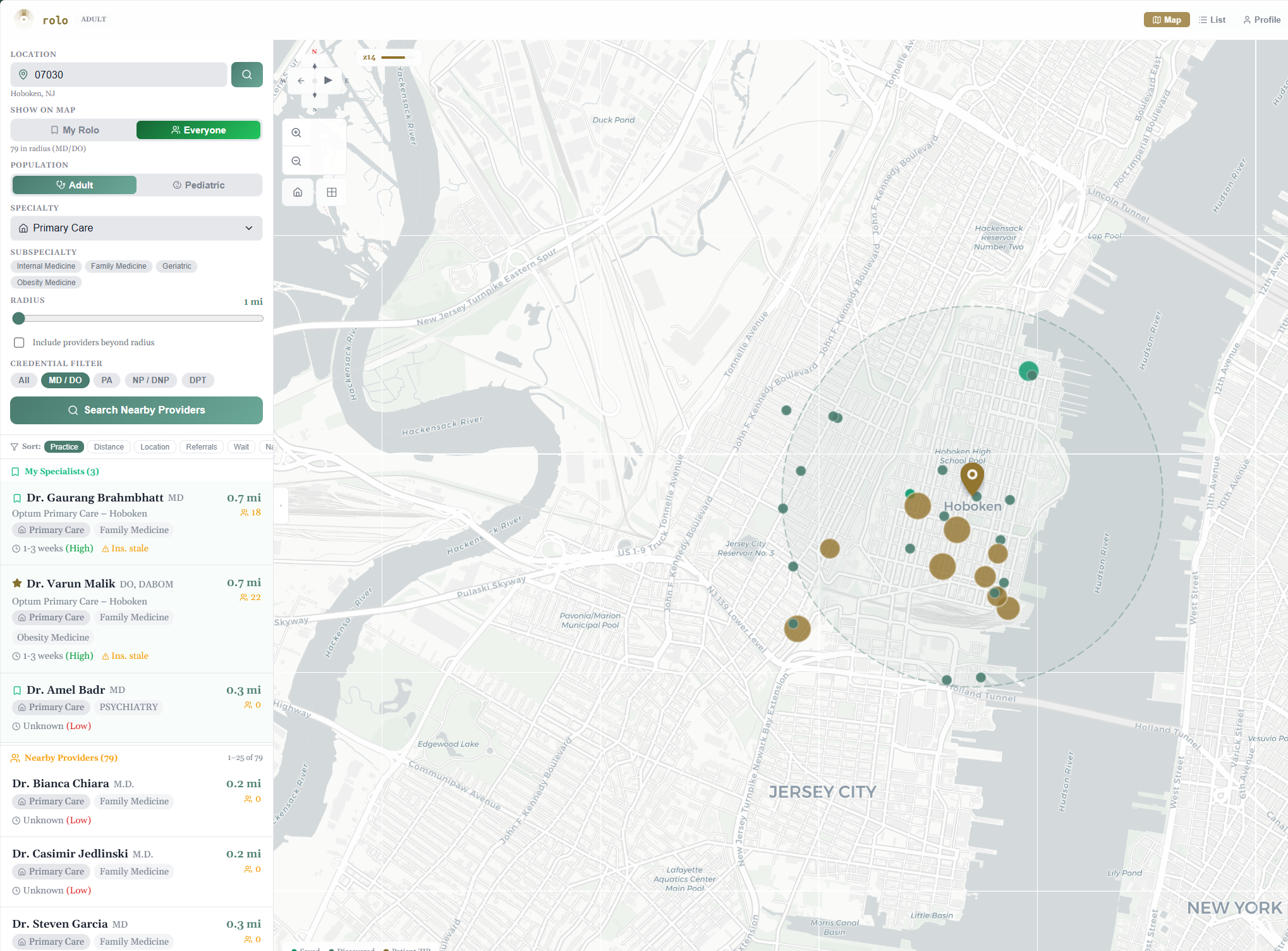
Set your patient's ZIP code and a search radius. Get a live map of clinicians actually practicing nearby — filtered by specialty, credential type, insurance coverage, and pediatric or adult scope. Distance-based, not network-based.

03

Build your rolodex over time

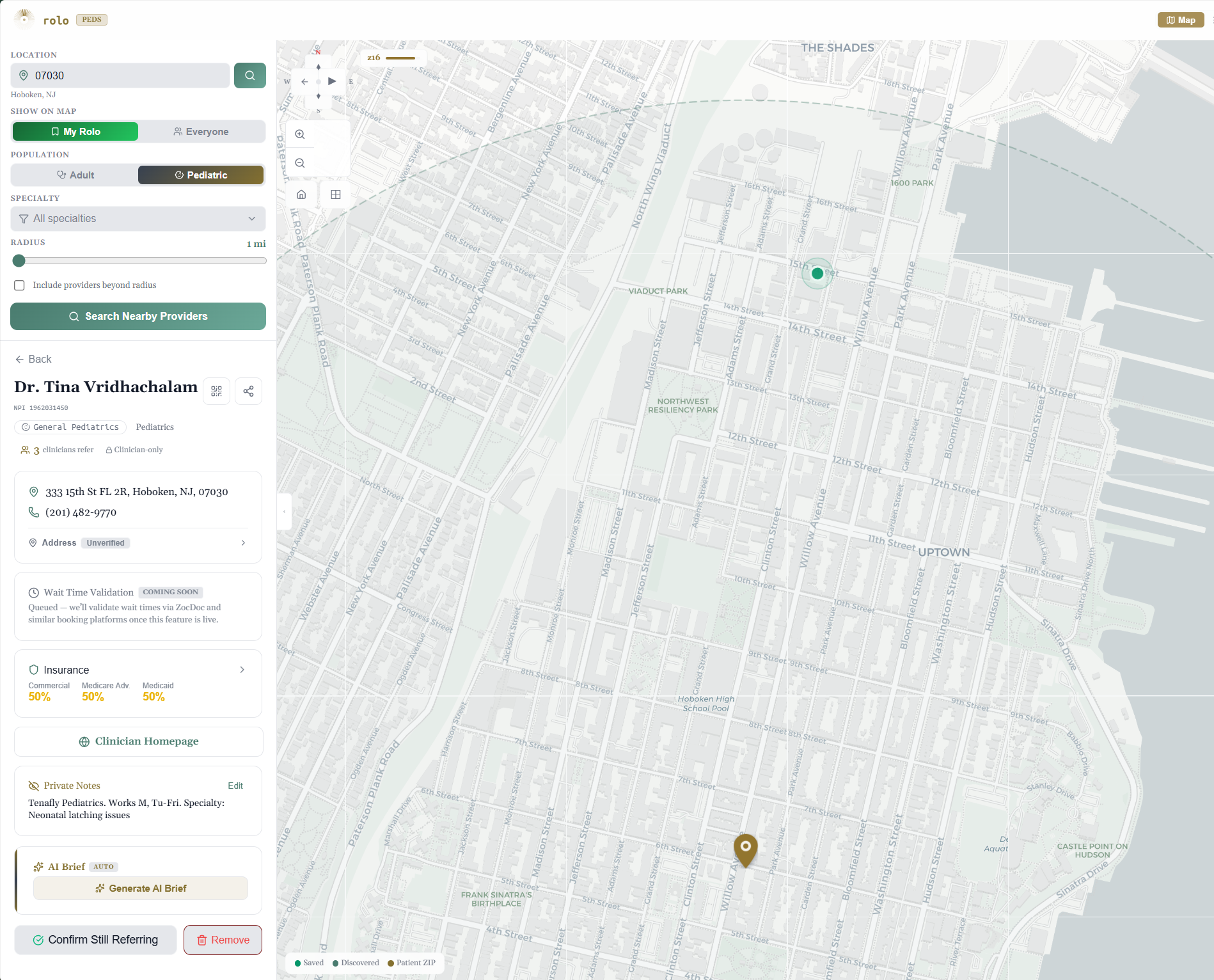
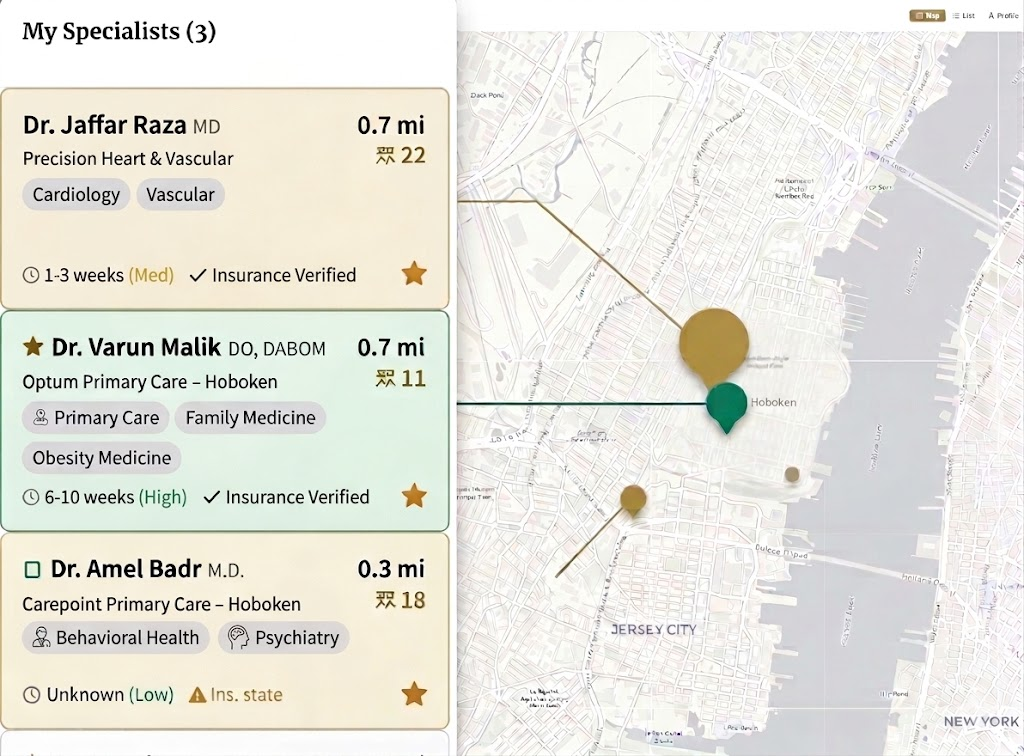
Save the clinicians you trust. Your rolodex is private, tied to your NPI, and travels with you wherever your career takes you. Over time it becomes a map of your referral network — who you trust, across specialties and geographies.

04

A network that reflects how medicine actually works

Referral relationships don't follow insurance contracts — they follow trust. rolo is building the infrastructure for that layer: clinician-to-clinician, specialty-agnostic, and independent of which system you happen to be enrolled in today.

A referral is not a neutral transaction. It is a statement of trust, a reflection of clinical values, and an expression of who you serve.

86k+
NJ clinicians indexed
Cross-validated from NPPES, CMS, clinic sites, and geocoding. A living dataset, not a static snapshot.
~40%
Registry entries with stale data
Estimated share of NPPES records with address discrepancies in active metro markets — clinicians who are practicing but unfindable.
0
Other tools for this use case
No existing tool captures the clinician-to-clinician referral relationship as data. rolo is the first attempt to make that layer visible.
Built For

Every clinician
in the referral chain.

Primary Care Physicians

You make referrals every day, and your actual referral list has almost nothing to do with who's in-network. rolo is built for your real workflow — finding the specialist you trust, for the patient in front of you, in the geography you serve.

💊

Pharmacists, PAs & NPs

Referral relationships aren't exclusive to physicians. rolo is credential-neutral by design — your NPI is your identity on the platform, regardless of your degree. If you refer, you belong here.

🔬

Specialists Wanting to Be Found

If your NPPES address is stale, you're invisible to colleagues trying to refer to you. rolo surfaces you based on where you're actually practicing — and lets clinicians in your area add you to their trusted rolodex.

🏥

Independent & Community Practices

Community-based practices often lose referrals to large academic centers — not because of quality, but because of discoverability. rolo levels the discovery layer, so proximity and trust can compete with brand recognition.

Early Access

Join the network.
It's free.

rolo is free for all clinicians. Onboarding takes 60 seconds. Your rolodex stays with you, travels with your career, and grows with every colleague you trust.

Enter your NPI or select your state — either works.

No patient data collected. Your network, your data. Clinician-owned.